Sugar Free Peanut Butter Manufacturer & Supplier In Israel
Demand for simple, protein-rich spreads continues to grow across retail, fitness, and foodservice channels. For Israeli importers, distributors, and private-label brands, choosing a sugar free peanut butter manufacturer in India involves more than comparing prices. The product must deliver good flavor, reliable texture, safe packaging, and clear documentation.
Buyers must also decide whether they need a sugar-free, no-added-sugar, or peanuts-only product. These claims do not mean the same thing. This guide explains formulation choices, quality controls, packaging, private-label planning, and export points for companies sourcing peanut butter for Israel.
Why Israeli Buyers Are Choosing Sugar Free Peanut Butter
Demand for protein-rich and clean-label spreads
Peanuts are naturally rich in protein and have a familiar roasted flavor. This makes peanut butter suitable for breakfast, snacks, baking, fitness meals, and commercial food preparation. A simple ingredient list may also appeal to shoppers who want fewer additives.
A protein rich spread can be sold through supermarkets, health-food shops, online grocery platforms, and sports-nutrition stores. Hotels, cafes, bakeries, and institutional kitchens may use it in sauces, desserts, smoothies, and ready-to-eat meals.
Sugar free versus no added sugar
“Sugar free” and “no added sugar” should not be treated as equal claims. A no added sugar formulation usually means that sugar or sugar-containing ingredients were not added. However, peanuts contain small amounts of naturally occurring sugar.
The finished product must meet the applicable legal limit before it is described as sugar free. Buyers should select the intended claim early, test the final product, and have the wording reviewed for the Israeli market. “Unsweetened,” “no added sugar,” or “100% peanuts” may be suitable alternatives only when the recipe and local rules support them.
Retail and foodservice opportunities
Sugar free peanut butter for retail can serve families, fitness shoppers, and consumers seeking a natural peanut spread. Supermarket products usually need stable texture, easy spreadability, strong shelf appeal, and clear nutrition information.
Sugar free peanut butter for foodservice may have different needs. Commercial users often focus on pack handling, recipe performance, portion cost, and consistent peanut paste consistency from one batch to the next.
What Makes High-Quality Sugar Free Peanut Butter?
Roasted groundnuts and flavor development
The quality of roasted groundnuts has a direct effect on flavor, color, and aroma. Fresh peanuts and a controlled roast can create a balanced taste. Excess roasting may lead to dark color or bitterness, while a light roast may produce a weaker peanut flavor.
Private-label buyers should agree on an expected roast profile. This helps keep the product consistent across repeat orders and reduces unwanted variation on the retail shelf.
Creamy and crunchy peanut butter
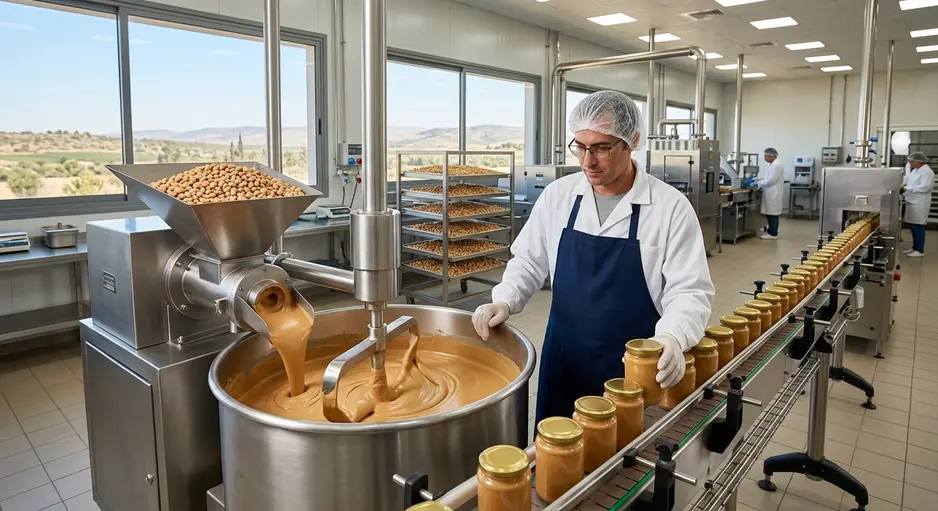
Creamy peanut butter is ground to create a smooth, easy-to-spread texture. Particle size, grinding time, and processing temperature all affect the final result. This format is often used in retail jars, sauces, smoothies, and bakery recipes.
Crunchy peanut butter includes peanut pieces for added bite. The size and amount of the pieces should be defined in the specification. Both formats can work well in supermarkets. The right choice depends on the target customer and the brand’s position.
Oil separation and spreadability
Some oil separation is normal in a peanuts-only product. It does not always signal poor quality. Yet too much separation can affect appearance, handling, and consumer satisfaction.
Manufacturers can manage oil separation control through raw-material selection, grinding settings, mixing, temperature control, and recipe design. Approved stabilizing ingredients may also be considered when the buyer wants a more uniform texture. This choice should match the desired clean-label position.
Clean-label ingredient options
A product brief may request one of several simple recipes:
- Peanuts only
- Peanuts and salt
- Peanuts, salt, and approved stabilizing ingredients
- A buyer-specific private label formulation
A natural-food brand may accept mild separation in return for a shorter ingredient list. A large retailer may prefer a stable product that spreads in the same way throughout its shelf life. Neither approach is automatically better; it depends on the market.
How to Evaluate a Peanut Butter Manufacturer in India
Food safety standards and documentation
Food safety should be reviewed before pricing and production are finalized. Buyers should ask for current documents rather than relying on broad quality claims. Any certification should be checked for its scope, validity, and relevance to the production site.
A supplier review may cover:
- Product specifications and ingredient declarations
- HACCP-based food safety controls
- Batch traceability records
- Allergen management procedures
- Certificates of analysis
- Recall and complaint processes
- Packaging and finished-product checks
Aflatoxin and microbiological controls
Aflatoxin control is important when sourcing peanut products. A suitable plan may include approved raw-material suppliers, incoming checks, sampling, and laboratory testing. Buyers and manufacturers should agree on measurable limits before commercial production begins.
Microbiological criteria are also important because peanut butter is a ready-to-eat food. The specification should identify required tests, sampling frequency, test methods, and the action taken if a batch does not comply.
Shelf-life stability for export
International shipping can expose products to changing temperatures and long transit periods. Shelf life stability should therefore be supported by appropriate evidence, not by a general promise.
Evaluation may include flavor, oxidative rancidity, texture, color, oil movement, seal performance, and packaging integrity. Storage instructions should match the test conditions and expected supply chain.
Questions to ask a potential supplier
- Can the supplier develop creamy and crunchy versions?
- Are samples or pilot batches available for review?
- What are the minimum order quantities and lead times?
- Which documents accompany each shipment?
- How are peanuts and other allergens controlled?
- Can the recipe be matched to a target specification?
- What packaging and coding options can be confirmed?
- How is shelf life assessed?
Packaging for Retail, Supermarkets, and Foodservice

Retail jar packaging
Retail jar packaging should protect the product while remaining convenient for consumers. Depending on the agreed supply program, buyers may assess PET or glass containers, induction seals, tamper-evident closures, label application, and batch coding.
Cartons must also withstand export handling. The jar, lid, seal, carton, and pallet plan should be tested as one packaging system. Final formats and available sizes must be confirmed with the manufacturer before artwork is prepared.
Sugar free peanut butter for supermarkets
Sugar free peanut butter for supermarkets needs a consistent fill weight and a clean shelf-ready appearance. Buyers should define barcode position, case quantity, carton markings, pallet pattern, and label dimensions.
Private-label artwork should not be printed until the recipe, nutrition values, allergen wording, and importer information have been approved.
Bulk food packaging
Foodservice buyers may prefer food-grade tubs, pails, or another approved bulk food packaging format. Secure closures and clear handling instructions are important for bakeries, hotels, restaurants, and commercial kitchens.
The buyer should confirm whether the product will be scooped, pumped, mixed, or added to a production line. This helps set practical targets for viscosity and consistency.
Exporting Sugar Free Peanut Butter to Israel
Export labeling requirements
A sugar free peanut butter exporter to Israel should work closely with the local importer before packaging is printed. Depending on current requirements, the label may need Hebrew product information and other market-specific details.
Items commonly reviewed include:
- Product name and ingredient list
- A clear peanut allergen declaration
- Nutrition information and net quantity
- Manufacturer and importer details
- Country of origin
- Lot or batch identification
- Best-before date and storage instructions
Rules can change. Final artwork should be approved by the Israeli importer or a qualified regulatory adviser and checked against current Israel Ministry of Health requirements before printing.
Can the label say “sugar free”?
The answer depends on the tested sugar content and the current legal threshold. Peanuts contain naturally occurring sugars, even when no sweetener is added. A laboratory-backed nutrition panel should support the chosen claim.
Buyers should avoid assuming that a peanuts-only recipe is automatically sugar free. The same care applies to website descriptions, sales sheets, and supermarket listings.
Kosher requirements
Kosher certification can be commercially important for some Israeli supermarkets, distributors, institutions, and foodservice accounts. It is not safe to assume that every buyer needs the same approval.
The importer should confirm whether certification is required and which certifying authority is accepted. This discussion should take place before ingredients, production plans, and packaging are finalized.
Essential shipping documents
Documents vary by shipment and importer. The commercial file may include an invoice, packing list, certificate of origin, transport document, product specification, allergen statement, and certificate of analysis. Health, sanitary, or insurance documents may also apply.
Private Label Sugar Free Peanut Butter Strategy
Begin with a clear product brief
A detailed brief reduces delays and costly revisions. It should define the target texture, recipe, salt level, sweetener restrictions, oil separation tolerance, nutrition goals, packaging, shelf life, expected volume, and certification needs.
The buyer should also share where the product will be sold. A jar for online retail may need different transit protection from a product supplied in bulk to a bakery.
Approve samples before scaling
- Share the target market and product requirements.
- Review the proposed recipe and specification.
- Assess laboratory or pilot samples.
- Complete nutrition and stability testing.
- Approve packaging and Hebrew label content.
- Confirm quantities, timelines, and quality checks.
- Begin production against the approved specification.
Compare value, not price alone
The lowest quote may not offer the lowest total cost. Buyers should consider batch consistency, testing, communication, packaging reliability, rejected-product risk, and export documentation.
An approved specification sheet should act as the quality benchmark for each shipment. It can define roast profile, particle size, viscosity, oil separation, microbiological limits, aflatoxin limits, fill weight, and packaging checks.
Working With Nutrionex Foods

Businesses looking for an Indian supply partner can contact Nutrionex Foods to discuss their intended product and market. This may include importers, distributors, supermarkets, private-label businesses, and foodservice companies sourcing for Israel.
Before placing an order, request written confirmation of available formulations, packaging formats, minimum quantities, production timelines, quality documents, certifications, and export support. These details should be matched to the buyer’s specification and current Israeli requirements.
Contact Nutrionex Foods to discuss formulation needs, samples, packaging, order quantities, and documentation for the Israeli market.
Sugar Free Peanut Butter Manufacturer & Supplier in Israel
Build a Reliable Peanut Butter Supply Program
Selecting a supplier requires a clear recipe, measurable specifications, safe packaging, and accurate market labels. Buyers should also verify testing methods, allergen controls, shelf-life evidence, documentation, and production timelines.
When assessing a sugar free peanut butter manufacturer in India, begin with samples and an approved specification. Confirm the legal product claim before printing labels, and involve the Israeli importer at every compliance stage.
A well-planned supply program protects product quality, supports repeat orders, and gives retailers and foodservice buyers greater confidence in every shipment.
Frequently Asked Questions
1. Is sugar free peanut butter the same as no added sugar peanut butter?
No. No added sugar usually means that sugar or sugar-containing ingredients were not added. A sugar-free claim depends on the final product meeting the applicable legal limit.
2. What ingredients can sugar free peanut butter contain?
The recipe may contain peanuts only, peanuts with salt, or approved ingredients used to improve texture and stability. The completed product still needs testing before a sugar-free claim is made.
3. Is creamy or crunchy peanut butter better for retail?
Both can work well. Creamy products provide smooth spreadability, while crunchy products add texture. Consumer preference, brand position, and intended use should guide the choice.
4. How is oil separation controlled?
It can be managed through peanut selection, grinding, mixing, processing conditions, and recipe design. Permitted stabilizers may also be used when they fit the label strategy.
5. Does peanut butter for Israel need Hebrew labeling?
Imported packaged food commonly requires market-specific information in Hebrew. The importer should confirm all mandatory content and approve the final artwork before printing.